FUNCTIONS OF MANAGEMENT
According to Henry Fayol,
“To manage is to forecast and plan, to organize, to command, and to control.”
Whereas Luther Gullick has given a keyword ‘POSDCORB’, where:
- P stands for Planning
- O for Organizing
- S for Staffing
- D for Directing
- Co for Co-ordination
- R for Reporting
- B for Budgeting
But the most widely accepted functions of management are given by Koontz and O’Donnell, i.e. Planning, Organizing, Staffing, Directing, and Controlling.
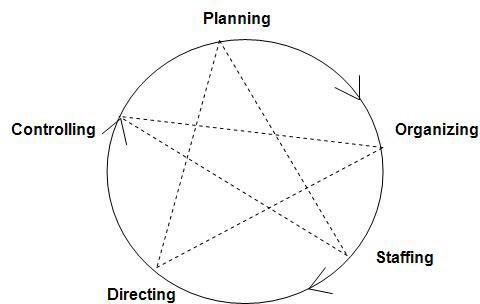
1. Planning
It is the basic function of management. It deals with chalking out a future course of action and deciding in advance the most appropriate course of actions for achievement of pre-determined goals.
According to Koontz,
“Planning is deciding in advance what to do, when to do, and how to do. It bridges the gap from where we are and where we want to be.”
A plan is a future course of action. It is an exercise in problem solving and decision making. Planning is determination of courses of action to achieve desired goals. Thus, planning is a systematic thinking about ways and means for accomplishment of pre-determined goals.
Planning is necessary to ensure proper utilization of human and non-human resources. It is all-pervasive, it is an intellectual activity, and it also helps in avoiding confusion, uncertainties, risks, wastages, etc.
2. Organizing
It is the process of bringing together physical, financial, and human resources and developing productive relationships amongst them for achievement of organizational goals.
According to Henry Fayol,
“To organize a business is to provide it with everything useful for its functioning, i.e. raw material, tools, capital and personnel.”
To organize a business involves determining and providing human and non-human resources to the organizational structure.
Organizing as a process involves:
- Identification of activities
- Classification and grouping of activities
- Assignment of duties
- Delegation of authority and creation of responsibility
- Coordinating authority and responsibility relationships
3. Staffing
It is the function of manning the organization structure and keeping it manned. Staffing has assumed greater importance in recent years due to advancement of technology, increase in size of business, complexity of human behavior, etc.
The main purpose of staffing is to put the right man on the right job, i.e. square pegs in square holes and round pegs in round holes.
According to Koontz and O’Donnell,
“Managerial function of staffing involves manning the organization structure through proper and effective selection, appraisal and development of personnel to fill the roles designed in the structure.”
Staffing involves:
- Manpower planning (estimating manpower in terms of searching, choosing the person, and giving the right place)
- Recruitment, selection, and placement
- Training and development
- Remuneration
- Performance appraisal
- Promotions and transfers
4. Directing
It is that part of the managerial function which actuates the organizational methods to work efficiently for achievement of organizational purposes. It is considered the life-spark of the enterprise which sets it in motion, because planning, organizing, and staffing are mere preparations for doing the work.
Direction is that inter-personnel aspect of management which deals directly with influencing, guiding, supervising, and motivating subordinates for the achievement of organizational goals.
Direction has the following elements:
- Supervision
- Motivation
- Leadership
- Communication
Supervision
Implies overseeing the work of subordinates by their superiors. It is the act of watching and directing work and workers.
Motivation
Means inspiring, stimulating, or encouraging subordinates with zeal to work. Positive, negative, monetary, and non-monetary incentives may be used for this purpose.
Leadership
May be defined as a process by which a manager guides and influences the work of subordinates in the desired direction.
Communication
Is the process of passing information, experience, opinion, etc., from one person to another. It is a bridge of understanding.
5. Controlling
It implies measurement of accomplishment against the standards and correction of deviation, if any, to ensure achievement of organizational goals. The purpose of controlling is to ensure that everything occurs in conformity with the standards.
An efficient system of control helps to predict deviations before they actually occur.
According to Theo Haimann,
“Controlling is the process of checking whether or not proper progress is being made towards the objectives and goals and acting, if necessary, to correct any deviation.”
According to Koontz and O’Donnell,
“Controlling is the measurement and correction of performance activities of subordinates in order to make sure that the enterprise objectives and plans devised to obtain them are being accomplished.”
Therefore, controlling has the following steps:
- Establishment of standard performance
- Measurement of actual performance
- Comparison of actual performance with the standards and finding out deviation, if any
- Corrective action