Basic Communication - Multiplexing Techniques
4.1 Meaning of Multiplexing
In modern communication systems, the available transmission media (such as cables, optical fibers, or radio spectrum) are expensive and limited. If only one signal is sent at a time, the medium will be poorly utilized and the overall system becomes inefficient and costly.
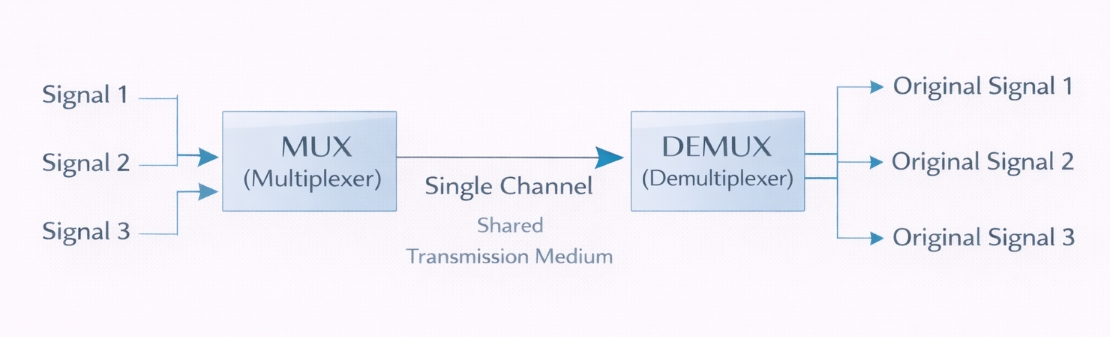
Multiplexing is a technique that allows multiple signals to share a single transmission medium simultaneously.
In multiplexing:
- Several independent signals are combined at the transmitter using a multiplexer (MUX).
- The combined signal is transmitted over a single channel.
- At the receiver, a demultiplexer (DEMUX) separates the original signals.
Need of Multiplexing
Multiplexing plays a key role in telephone networks, mobile networks, TV broadcasting, internet backbones, and optical fiber systems.
- To use bandwidth efficiently
- To reduce the cost of transmission media
- To allow many users to communicate at the same time
- To increase the capacity of communication systems
- To make better use of high-speed links such as optical fiber and radio spectrum
4.2 Types of Multiplexing
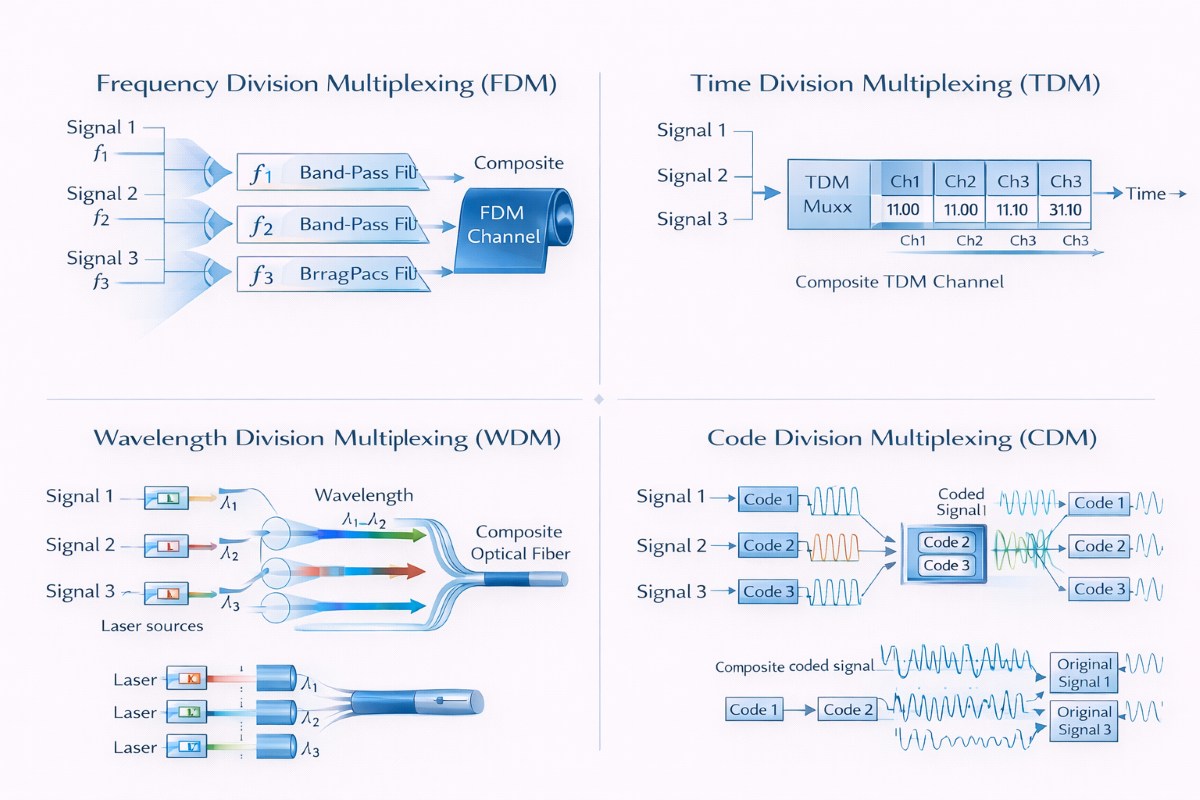
There are several ways to share a single channel among multiple signals. The most important types are:
(a) Frequency Division Multiplexing (FDM)
In Frequency Division Multiplexing, the available bandwidth of the channel is divided into several smaller frequency bands. Each signal is assigned a different frequency band, and all signals are transmitted simultaneously over the same medium.
In FDM, each user occupies a different frequency.
Working Principle
- The total channel bandwidth is split into non-overlapping frequency slots.
- Each message signal is modulated onto a different carrier frequency.
- All modulated signals are combined and transmitted together.
- At the receiver, band-pass filters are used to separate each frequency band and recover the original signals.
Features of FDM
- Signals are transmitted at the same time
- Separation is done in the frequency domain
- Requires guard bands between channels to avoid overlap and interference
Applications
- Radio broadcasting
- TV broadcasting
- Cable TV systems
- Older telephone carrier systems
Advantages
- Simple and well-established technique
- No need for strict time synchronization
- Continuous transmission of each signal
Disadvantages
- Wastes bandwidth due to guard bands
- More susceptible to noise and interference
- Not very efficient for digital systems
(b) Time Division Multiplexing (TDM)
In Time Division Multiplexing, all signals use the same frequency band, but they are transmitted in different time slots. Each signal gets the channel for a short duration, one after another, in a repeating sequence called a frame.
In TDM, each user occupies the same frequency but at different times.
Working Principle
- The time is divided into small slots.
- Each input signal is assigned a specific time slot in every frame.
- During its time slot, a signal transmits its data.
- At the receiver, the demultiplexer uses timing information to separate the signals.
Types of TDM
- Synchronous TDM: Each channel gets a fixed time slot, even if it has no data.
- Statistical (Asynchronous) TDM: Time slots are assigned dynamically to active channels only, improving efficiency.
Applications
- Digital telephony
- PCM systems
- Computer networks and data links
Advantages
- Efficient use of bandwidth for digital data
- No need for guard bands like FDM
- Suitable for high-speed digital systems
Disadvantages
- Requires precise synchronization between transmitter and receiver
- If one channel fails, it may affect timing of others
- In synchronous TDM, empty slots may waste capacity
(c) Wavelength Division Multiplexing (WDM)
Wavelength Division Multiplexing is a special form of FDM used in optical fiber communication. Instead of using different frequencies, WDM uses different wavelengths (colors) of light to carry different signals through the same optical fiber.
In WDM, each signal is transmitted using a different wavelength of light in the same fiber.
Working Principle
- Multiple laser sources generate light at different wavelengths.
- Each wavelength carries a separate data signal.
- These wavelengths are combined and sent through a single optical fiber.
- At the receiver, an optical demultiplexer separates the wavelengths and recovers the original signals.
Types of WDM
- CWDM (Coarse WDM) – Fewer channels, larger spacing
- DWDM (Dense WDM) – Many channels, very close spacing, very high capacity
Applications
- Optical fiber backbone networks
- FTTH (Fiber to the Home)
- High-speed internet and telecom core networks
Advantages
- Enormously increases fiber capacity
- Makes best use of optical fiber bandwidth
- Allows future expansion by adding more wavelengths
Disadvantages
- More expensive and complex equipment
- Requires precise optical components
(d) Code Division Multiplexing (CDM)
In Code Division Multiplexing, all users transmit at the same time and using the same frequency band, but each user is assigned a unique code. The receiver uses this code to separate the desired signal from others.
In CDM, all users share the same time and frequency, but are separated by codes.
Working Principle
- Each user’s data is multiplied by a unique spreading code.
- All coded signals are added together and transmitted.
- At the receiver, the desired user’s signal is recovered by using the same code.
- Signals with different codes appear as noise to each other.
Applications
- CDMA mobile communication systems
- 3G cellular systems
- Secure and military communication systems
Advantages
- High resistance to interference and noise
- Better security and privacy
- Allows soft capacity (more users can be added with graceful performance degradation)
Disadvantages
- Complex transmitter and receiver
- Requires good code design and synchronization
- Performance depends on power control
Notes
- Multiplexing allows multiple signals to share a single transmission medium, improving bandwidth utilization and reducing cost.
- FDM separates signals by frequency.
- TDM separates signals by time slots.
- WDM separates signals by wavelengths of light in optical fiber.
- CDM separates signals using unique codes while sharing the same time and frequency.