Basic Telecommunications Concepts - Modulation and Demodulation
3. MODULATION AND DEMODULATION
3.1 Meaning of Modulation
In communication systems, the message signal (such as speech or music) is usually a low-frequency signal. Such low-frequency signals cannot be transmitted efficiently over long distances using antennas, and they also suffer more from noise and interference. To solve this problem, we use a high-frequency signal called a carrier.
Modulation is the process of imposing a low-frequency information signal (message) onto a high-frequency carrier signal by varying one of the carrier’s parameters: amplitude, frequency, or phase.
The basic modulation process can be represented as:
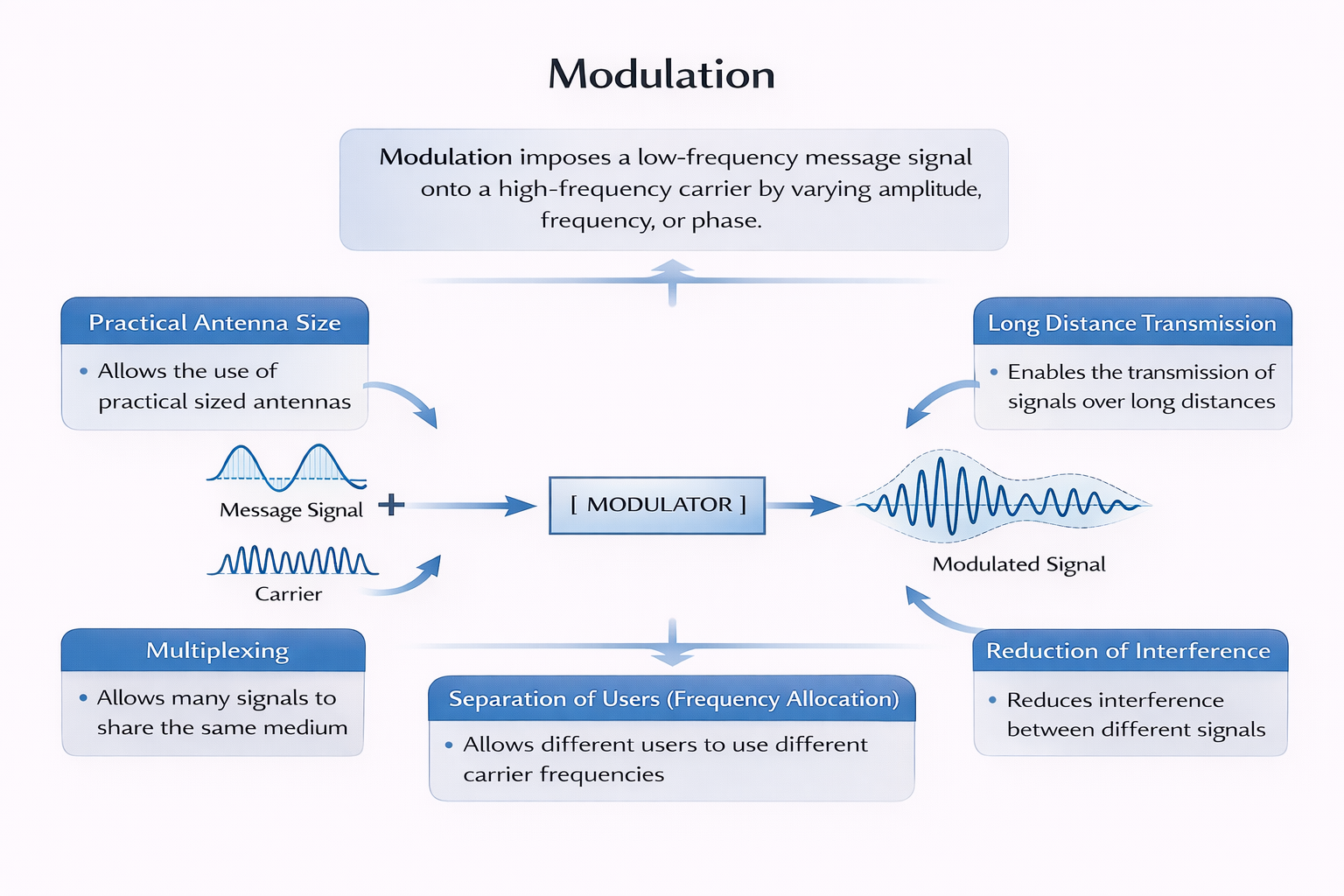
Here:
- Message signals contain the information (voice, data, etc.)
- Carrier signal is a high-frequency sinusoidal signal
- Modulator combines both to produce a modulated signal suitable for transmission
Depending on which parameter of the carrier is varied, modulation is classified into:
- Amplitude Modulation (AM) – amplitude varies
- Frequency Modulation (FM) – frequency varies
- Phase Modulation (PM) – phase varies
3.2 Why Modulation is Needed
Modulation is not just a technical choice—it is essential for practical communication. The main reasons are:
1. Practical Antenna Size
The height of an antenna is roughly proportional to the wavelength of the signal. Low-frequency signals have very large wavelengths, which would require very large antennas (hundreds of meters or more). By using a high-frequency carrier, the wavelength becomes smaller, and the antenna size becomes practical and manageable.
2. Long-Distance Transmission
High-frequency signals can travel longer distances and can be radiated efficiently by antennas. Low-frequency baseband signals cannot be transmitted efficiently over long distances through free space.
3. Separation of Different Users (Frequency Allocation)
If all users transmit low-frequency signals directly, their signals will mix together and cause interference. By assigning different carrier frequencies to different users, their signals can be separated easily at the receiver using filters.
4. Reduction of Interference
Modulation helps in organizing the frequency spectrum. Proper allocation of carrier frequencies and bandwidths reduces mutual interference between different communication channels.
5. Multiplexing of Many Signals
Using modulation, many signals can be transmitted simultaneously over the same medium by placing them on different carrier frequencies. This makes multiplexing possible and improves efficient use of bandwidth.
3.3 Analog Modulation
In analog modulation, the message signal is analog, and the carrier parameter is varied continuously according to the message.
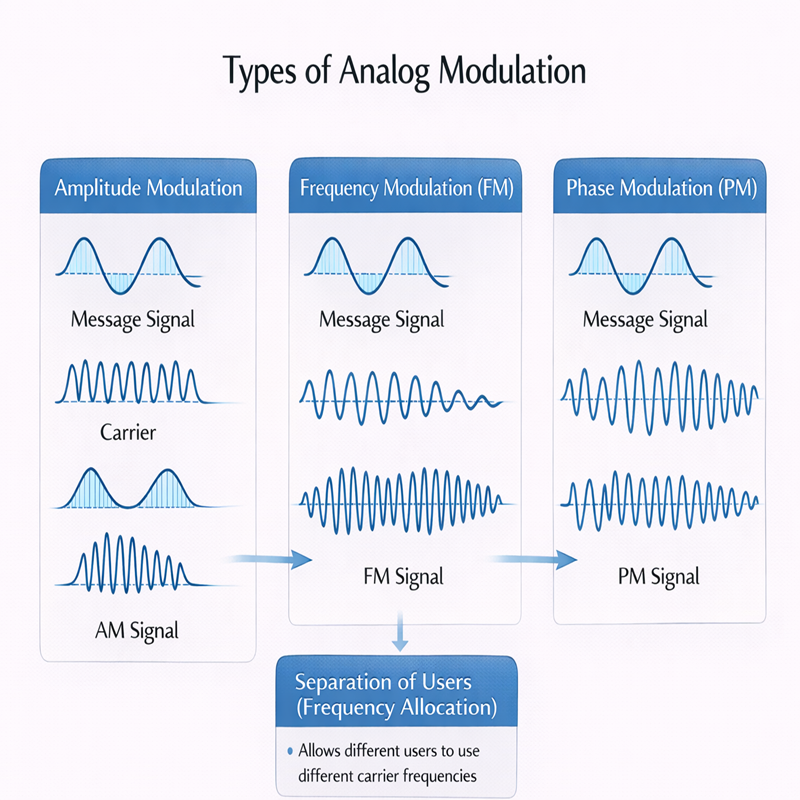
(a) Amplitude Modulation (AM)
In Amplitude Modulation, the amplitude of the carrier is varied in proportion to the instantaneous value of the message signal, while the frequency and phase of the carrier remain constant.
Features:
- Simple and easy to implement
- Used in medium-wave and short-wave radio broadcasting
- Requires simple receivers
Disadvantages:
- Highly affected by noise, because noise mainly affects amplitude
- Power inefficient (most power is wasted in the carrier)
- Bandwidth inefficient compared to FM and modern digital methods
So, AM is simple and cheap, but its performance is poor in noisy environments.
(b) Frequency Modulation (FM)
In Frequency Modulation, the frequency of the carrier is varied according to the message signal, while the amplitude remains constant.
Features:
- Much better noise immunity than AM, because noise mainly affects amplitude, not frequency
- Provides better sound quality
- Widely used in FM radio broadcasting, TV audio, and two-way radio communication
Disadvantages:
- Requires larger bandwidth than AM
- Transmitter and receiver circuits are more complex than AM
Thus, FM gives better quality and reliability, but at the cost of more bandwidth.
(c) Phase Modulation (PM)
In Phase Modulation, the phase of the carrier is varied according to the message signal, while amplitude and frequency remain constant.
Features:
- Closely related to FM (in fact, FM can be generated using PM and vice versa)
- Has good noise performance
- Widely used as a basis for digital modulation techniques
Applications:
- Used in modern communication systems and forms the basis of PSK (Phase Shift Keying) in digital modulation
3.4 Digital Modulation
In digital modulation, the message signal is digital (binary 0s and 1s), and the carrier is varied in discrete steps according to the data.
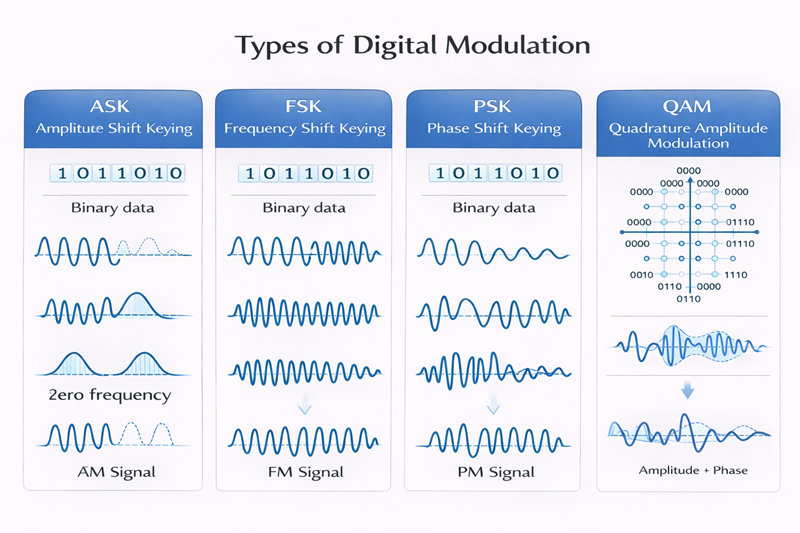
(a) Amplitude Shift Keying (ASK)
In ASK, the amplitude of the carrier changes according to the binary data:
- One amplitude for binary 1
- Another (or zero) amplitude for binary 0
Features:
- Simple to implement
- Highly noise sensitive, because noise affects amplitude
- Used in simple, low-cost communication systems
(b) Frequency Shift Keying (FSK)
In FSK, the frequency of the carrier changes according to the binary data:
- One frequency for binary 1
- Another frequency for binary 0
Features:
- Better noise performance than ASK
- Slightly more complex than ASK
- Used in modems, wireless communication, and data transmission systems
(c) Phase Shift Keying (PSK)
In PSK, the phase of the carrier changes according to the binary data:
- For example, in BPSK, one phase represents 1 and another phase represents 0
Features:
- Very good noise performance
- Power efficient
- Widely used in modern digital communication systems, satellite and mobile communication
(d) Quadrature Amplitude Modulation (QAM)
In QAM, both the amplitude and phase of the carrier are varied according to the data.
Features:
- Can transmit more bits per symbol
- Provides high data rate
- High spectral (bandwidth) efficiency
- Used in 4G, 5G, Wi-Fi, cable TV, and modern modems
Disadvantage:
- More complex and sensitive to noise compared to simpler schemes like FSK or BPSK
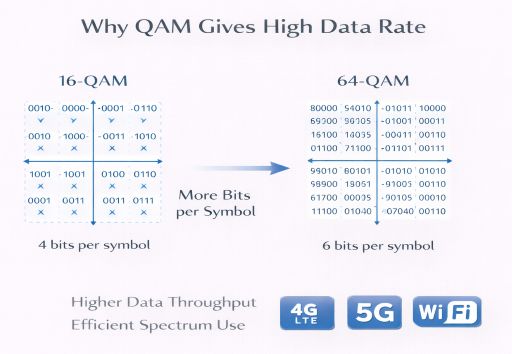
Why QAM Gives High Data Rate
Quadrature Amplitude Modulation (QAM) is a digital modulation technique in which both the amplitude and the phase of the carrier signal are varied simultaneously. Because of this, each transmitted symbol can represent multiple bits of data instead of just one bit. For example, in 16-QAM, each symbol represents 4 bits, and in 64-QAM, each symbol represents 6 bits. This means more information is sent in the same bandwidth, which directly results in a higher data rate.
In simple terms, QAM packs more bits into each signal change by using many different combinations of amplitude and phase. This makes QAM highly bandwidth-efficient compared to simpler schemes like ASK, FSK, or BPSK, where fewer bits are carried per symbol.
Use of QAM in 4G/5G and Wi-Fi
Modern communication systems such as 4G LTE, 5G, and Wi-Fi require very high data rates to support video streaming, online gaming, and high-speed internet. QAM is widely used in these systems because it can transmit large amounts of data within limited spectrum.
By using higher-order QAM schemes like 64-QAM, 256-QAM, or even 1024-QAM, these systems can increase data throughput without increasing bandwidth. Therefore, QAM plays a key role in achieving the high-speed performance of modern wireless networks.
3.5 Demodulation
At the receiver, the transmitted signal is no longer the original message; it is a modulated signal. To recover the original information, the reverse process of modulation is performed.
Demodulation is the process of extracting the original message signal from the modulated carrier signal.
This can be represented as:
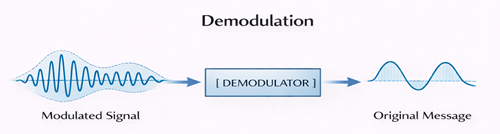
Functions of Demodulation:
- Separates the message signal from the carrier
- Removes the carrier component
- Produces an output that is a recovered version of the original information signal
Different modulation schemes require different demodulators, such as:
- AM detector for AM signals
- FM discriminator for FM signals
- Coherent or non-coherent detectors for digital modulation schemes
Revision -
- Modulation shifts a low-frequency message to a high-frequency carrier by varying amplitude, frequency, or phase.
- It is needed for practical antenna size, long-distance transmission, interference reduction, user separation, and multiplexing.
- Analog modulation includes AM, FM, and PM, each varying a different carrier parameter.
- Digital modulation includes ASK, FSK, PSK, and QAM, used for transmitting binary data efficiently.
- Demodulation is the reverse process used at the receiver to recover the original message signal.