Basic Communication - Spectrum Management
5.1 Spectrum
The electromagnetic spectrum is the range of all possible electromagnetic frequencies that can be used for communication. This includes radio waves, microwaves, infrared, visible light, and higher frequency bands. In telecommunications, we mainly use the radio and microwave portions of the spectrum for wireless communication and optical frequencies for fiber communication.
In simple words, spectrum is the “space” in which wireless signals travel.
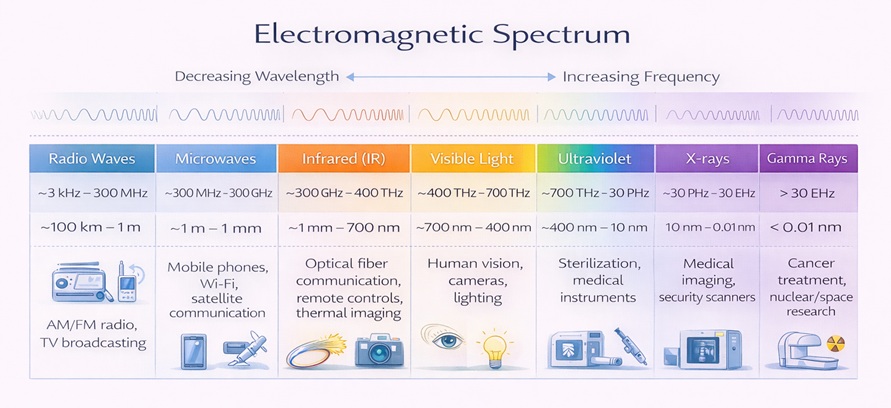
Every wireless service—such as mobile phones, radio, TV broadcasting, satellite communication, Wi-Fi, and Bluetooth—uses a specific part of the spectrum. Since the spectrum is finite and limited, it is considered a valuable natural resource. If it is not managed properly, signals can interfere with each other, leading to poor quality of service or even complete communication failure.
Therefore, spectrum must be:
- Planned carefully
- Allocated properly
- Used efficiently
5.2 Need for Spectrum Management
Because spectrum is limited and shared by many users and services, proper management is essential. The main reasons for spectrum management are:
(a) To Avoid Interference
If two services use the same or nearby frequencies without coordination, their signals can overlap and interfere, causing noise, distortion, or loss of communication. Spectrum management ensures that different services are separated by frequency, location, or time so that interference is minimized.
(b) To Ensure Fair and Efficient Allocation
Spectrum is a public resource, so it must be allocated in a fair and organized manner. Governments and regulators decide:
- Which service gets which frequency band
- How much bandwidth each service can use
- This ensures balanced and efficient use of available spectrum.
(c) To Support New Technologies
Modern technologies such as 4G, 5G, satellite communication, IoT, and broadband wireless services require large amounts of spectrum. Proper spectrum management helps in:
- Refarming old bands
- Introducing new bands
- Making space for new and future technologies
(d) To Prevent Wastage and Misuse
Without regulation, some parts of the spectrum might be overused while others remain unused. Spectrum management ensures:
- Optimal utilization of all bands
- Prevention of illegal or unauthorized usage
- Better planning for future expansion
5.3 Spectrum Allocation
Spectrum allocation is the process of assigning different frequency bands to different services and users.
Allocation is done by government and international regulatory bodies to ensure orderly and interference-free operation of communication systems.
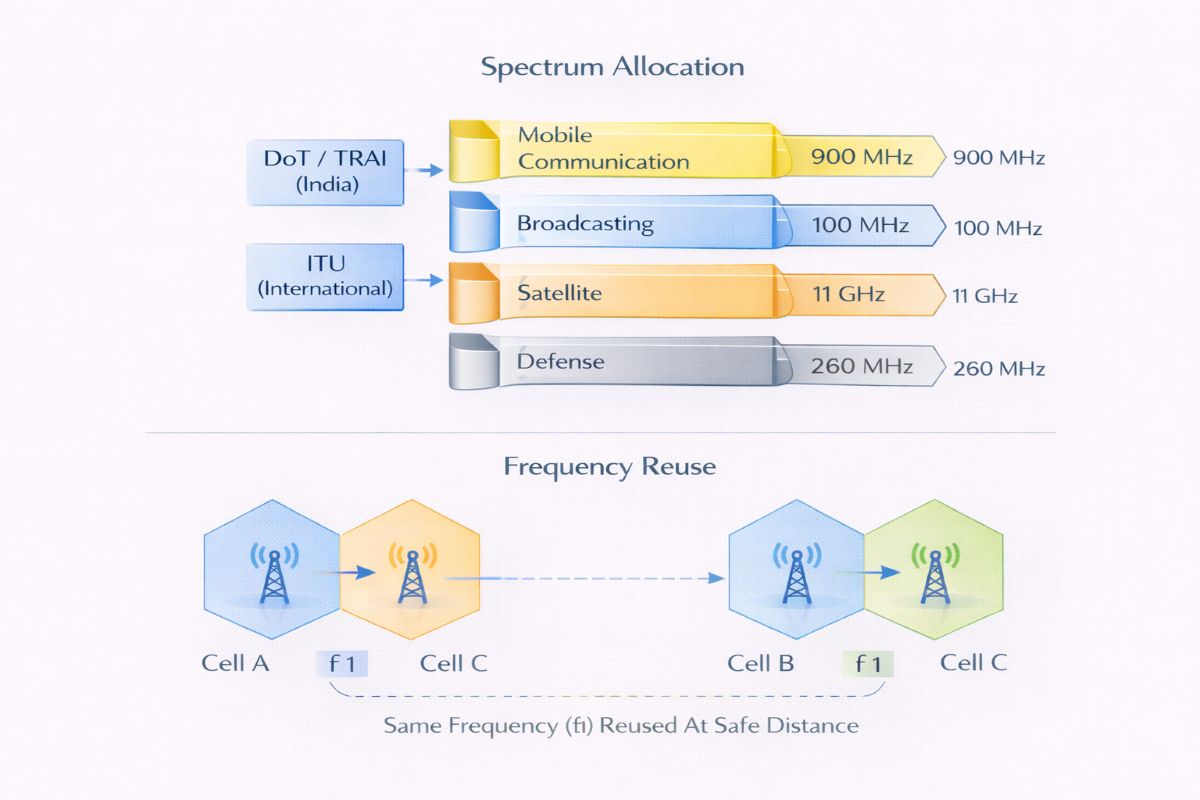
Regulatory Bodies
- In India:
- DoT (Department of Telecommunications) – Policy and administration
- TRAI (Telecom Regulatory Authority of India) – Regulation and recommendations
- Internationally:
- ITU (International Telecommunication Union) – A United Nations agency that coordinates global spectrum usage and standards so that countries do not interfere with each other’s systems.
Allocation to Different Services
Different parts of the spectrum are assigned to different services, for example:
- Mobile communication (2G, 3G, 4G, 5G)
- Radio and TV broadcasting
- Satellite communication
- Defense and navigation systems
- Wi-Fi and short-range devices
This organized allocation ensures smooth coexistence of multiple services without harmful interference.
5.4 Licensed and Unlicensed Bands
Spectrum can be broadly divided into licensed and unlicensed bands based on how they are used.
(a) Licensed Bands
Licensed bands are frequency bands that require official permission (license) from the government or regulator to use.
Features:
- Users must pay license fees or auction fees
- Usage is strictly controlled
- Provides better quality and less interference
- Mainly used by cellular operators and broadcasters
Examples:
- Cellular networks (2G, 3G, 4G, 5G)
- TV and radio broadcasting
- Satellite communication services
(b) Unlicensed Bands
Unlicensed bands can be used freely by anyone, as long as they follow certain technical limits such as low power and short range.
Features:
- No individual license required
- Lower cost and easy deployment
- More chance of interference because many users share the same band
- Used mainly for short-range communication
Examples:
- Wi-Fi
- Bluetooth
- ISM bands (Industrial, Scientific, Medical bands)
5.5 Frequency Reuse and Spectrum Efficiency
Because spectrum is limited, modern communication systems must use it as efficiently as possible. One very important technique to improve efficiency is frequency reuse, especially in cellular systems.
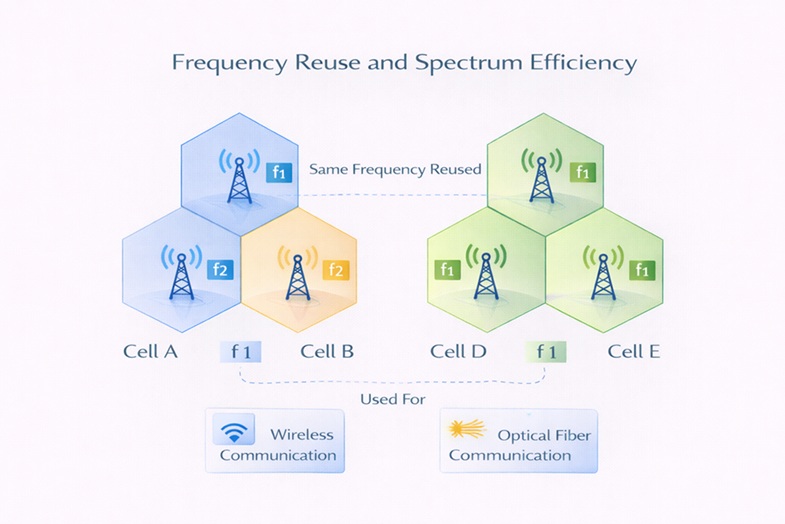
Frequency Reuse Concept
In a cellular network:
- The entire service area is divided into small cells
- The same frequency band can be reused in different cells that are far enough apart
- This prevents interference while serving more users
Advantages of Frequency Reuse
- Increases network capacity without increasing total spectrum
- Allows more users to be served simultaneously
- Improves spectrum efficiency
- Reduces the need for additional frequency bands
Spectrum Efficiency
Spectrum efficiency means transmitting more information using the same amount of spectrum. It is improved by:
- Frequency reuse
- Advanced modulation (e.g., QAM)
- Better coding and compression
- Modern technologies like 4G and 5G
Notes
- The spectrum is a limited and valuable natural resource used for communication.
- Spectrum management is necessary to avoid interference, ensure fair allocation, support new technologies, and prevent misuse.
- Spectrum allocation is done by regulatory bodies like DoT/TRAI in India and ITU internationally.
- Spectrum is divided into licensed and unlicensed bands depending on usage rights.
- Frequency reuse and other techniques improve spectrum efficiency and increase network capacity.