Big Five Personality Traits
The model proposes that human personality can be measured along five major dimensions, each of which is distinct and independent from the others.
Originally developed in 1949, the Big Five personality traits are a theory established by D. W. Fiske and later expanded upon by other researchers, including Norman (1967), Smith (1967), Lewis Goldberg (1981), and McCrae & Costa (1987).
Other Names of the Big Five Model
The Big Five model is also sometimes called:
- OCEAN
- CANOE
Both are acronyms of the five traits.
Big Five Traits (OCEAN)
- O – Openness
- C – Conscientiousness
- E – Extroversion
- A – Agreeableness
- N – Neuroticism (Emotional Stability)
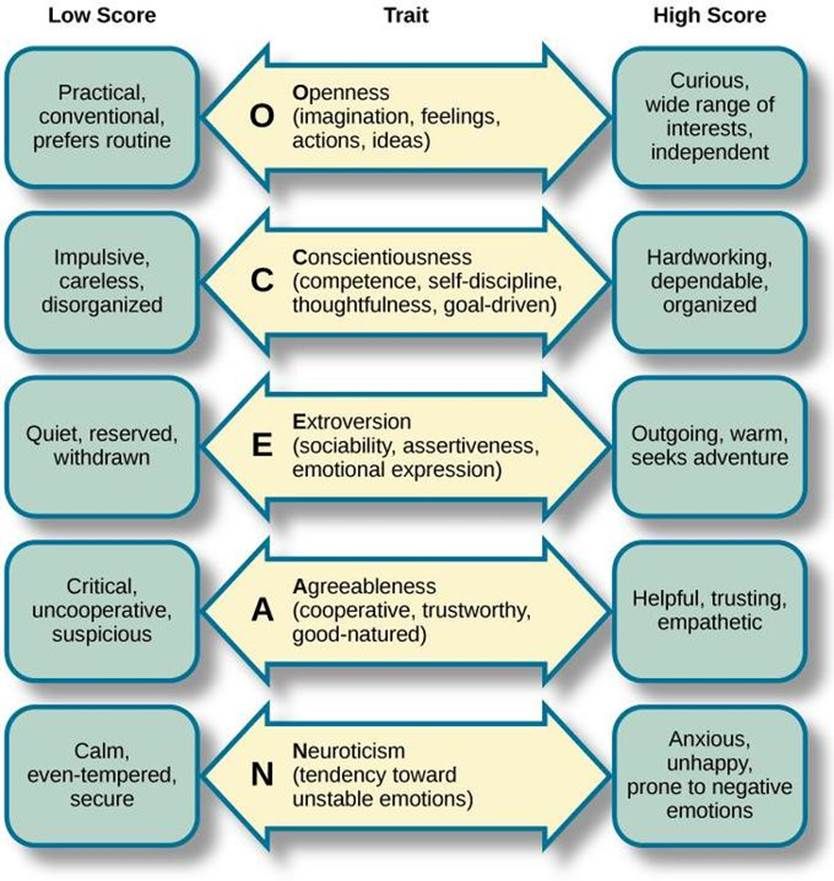
1. Openness to Experience
This trait features characteristics like creativity, curiosity, and a willingness to try new things. High scores indicate a love for adventure and new ideas, while low scores suggest a preference for routine and familiarity.
2. Conscientiousness
This trait reflects a person's level of organisation, dependability, and discipline. High conscientiousness is associated with being responsible and goal-oriented, while low scores may indicate a more laid-back and spontaneous approach.
3. Extraversion
This trait measures how outgoing and social a person is. High extraversion means someone enjoys being around people, is talkative, and energetic, while low extraversion (or introversion) indicates a preference for solitary activities and deep conversations.
4. Agreeableness
This trait encompasses qualities like kindness, empathy, and cooperativeness. High agreeableness means a person is friendly and compassionate, while low scores may indicate a more critical or competitive nature.
5. Neuroticism
This trait measures emotional stability and the tendency to experience negative emotions like anxiety or depression. High neuroticism indicates a higher likelihood of experiencing stress and emotional instability, while low neuroticism suggests a calmer and stable emotional state.