Cash Flow Analysis
Understand it first
In simple words: Cash flow is about timing: when money goes out (salaries, purchases) and when it comes in (client payments). A profitable project can still run short of cash if payments arrive late.
Think of it like: Your salary arrives on the 1st but rent is due on the 25th of the previous month; for a few days you may be short even though you earn enough.
Cumulative project spend against client payments received, excluding GST. A project can be profitable and still run short of cash in the middle.
Cumulative spend vs payments received
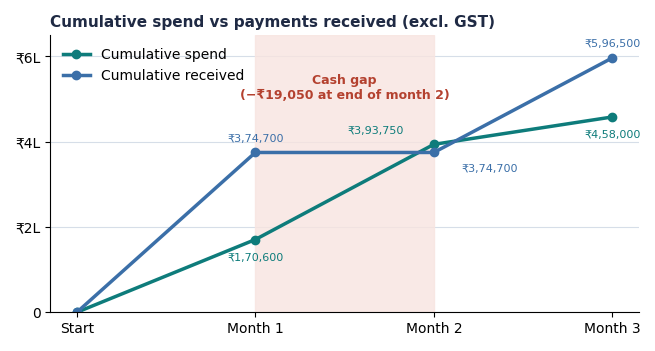
Monthly position
Point in time | Spend (₹) | Received (₹) | Position (₹) |
End of month 1 (M1 + M2 received) | 1,70,600 | 3,74,700 | +2,04,100 |
End of month 2 (no new payment) | 3,93,750 | 3,74,700 | −19,050 |
End of month 3 (M3 + M4 received) | 4,58,000 | 5,96,500 | +1,38,500 |
Cash gap: In month 2 spend runs ahead of payments by about ₹19,050, because development is the most expensive phase and the next payment (M3) only comes at UAT sign-off in week 9.
Payment milestones
Milestone | Trigger | Amount (₹) | Incl. GST (₹) |
M1 Advance 30% | PO signed (includes ₹42,000 third-party) | 2,08,350 | 2,45,853 |
M2 Design approval 30% | Design sign-off, week 4 | 1,66,350 | 1,96,293 |
M3 UAT sign-off 30% | UAT sign-off, week 9 | 1,66,350 | 1,96,293 |
M4 Go-live 10% | Launch and handover, week 10 | 55,450 | 65,431 |
Total | 5,96,500 | 7,03,870 |
How a PM manages the gap
- Invoice on the same day as each sign-off.
- Agree the M3 invoice date with the client early.
- Follow up payments before they are due (see lesson 32, Invoice and Payment Tracker).
- Keep a 30% advance clause as standard.
Key takeaways
- Payments are tied to milestones, so cash comes in steps.
- Development (month 2) is the most expensive phase, but no payment arrives then.
- Invoicing promptly and agreeing payment dates early reduces the gap.
Next lesson: 5. Document Register