Cost to Price Analysis
Understand it first
In simple words: This lesson shows how a PM turns cost into price. Cost is what the project costs our company (people's time, tools). Price is what we charge the client. Price = cost + reserve for risks + profit margin.
Think of it like: A tailor pays ₹1,000 for cloth and labour, adds ₹200 in case of mistakes and ₹300 profit, and quotes ₹1,500.
How each line of the client proposal traces back to the internal budget. This is how a PM turns a cost estimate into a price.
Service cost vs client price by phase
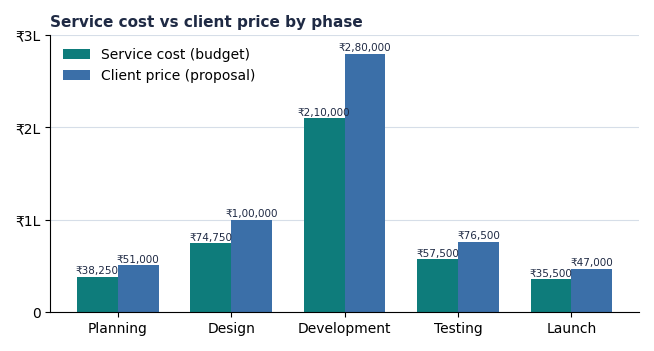
Phase | Service cost (₹) | Client price (₹) | Markup |
Planning | 38,250 | 51,000 | 33% |
Design | 74,750 | 1,00,000 | 34% |
Development | 2,10,000 | 2,80,000 | 33% |
Testing | 57,500 | 76,500 | 33% |
Launch | 35,500 | 47,000 | 32% |
Total | 4,16,000 | 5,54,500 | 33% |
Cost build-up to price
Line | Amount (₹) |
Labour (560 hours) | 4,02,000 |
Tools and training materials | 14,000 |
Service cost | 4,16,000 |
+ Contingency (10%) | 45,800 |
+ Gross margin | 92,700 |
Professional services (A) | 5,54,500 |
Third-party items at cost (B) | 42,000 |
Price before tax | 5,96,500 |
+ GST 18% | 1,07,370 |
Grand total | 7,03,870 |
Management reserve: The management reserve (₹22,900) is not priced in. If it is fully used, margin falls to ₹69,800 (11.7%).
Risks turned into billable items
Each contingency reserve in the budget is matched by a clause in the proposal that protects it.
Risk | Reserve (₹) | Proposal protection |
Third design round | 14,000 | Extra round billed at ₹18,000 |
Integration issues | 12,750 | Integrations excluded from scope |
Late content | 11,000 | Launch moves day for day |
Price increases | 8,050 | Renewals paid by client |
Learning point: Third-party items (domain, hosting, licences) are passed through at cost and bought in the client's name. Margin is earned only on professional services.
Key takeaways
- Markup is profit as a % of cost; margin is profit as a % of price. Here, margin is 15.5% of price.
- Third-party items (hosting, domain) are charged at cost, with no margin.
- Each risk reserve is protected by a clause in the proposal.
Next lesson: 4. Cash Flow Analysis